
In Interview: What Can We Learn from the Past for the Future of the High Streets
Series 1 / Episode 2 of 10
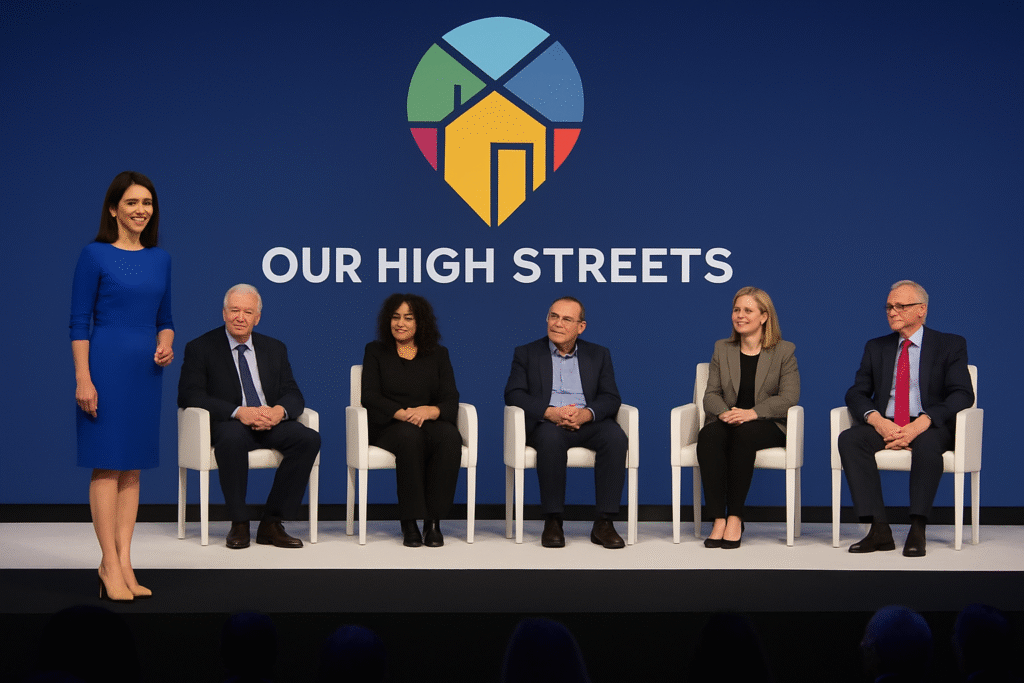
Taking inspirations from other already aired programs where guests are asked who would like to have dinner with or be on a desert island with, Our High Streets have created a whole series of panelist interviews by using the power of AI. We hope you enjoy and find while they are a bit of fun to do, we hope they are also open to create thoughtful conversation on how we look at pioneers from the past into today’s climate.
In this first interview, we have the following panelists:
- Sir Terence Conran – Designer, retailer, and founder of Habitat, known for bringing modern design to the British high street.
- Anita Roddick – Founder of The Body Shop, a pioneer of ethical retailing and sustainability in high street business.
- Jan Gehl – Danish architect and urban designer whose people-first design philosophy has influenced placemaking globally, including in the UK.
- Claire Dykta – British planning and regeneration professional known for her work in town centre strategy, housing delivery, and policy alignment (especially via Homes England).
- Lord Richard Rogers – Architect and urbanist behind the London Plan and major regeneration frameworks, champion of compact cities and sustainable urbanism.
“Good evening, and welcome to our special programme: ‘What Can We Learn from the Past for the Future of the High Streets’. I’m your host, Christina and tonight we have a truly extraordinary panel — visionaries and pioneers from the past 200 years, brought together through the wonders of imagination and historical research, to discuss the future of the UK’s high streets.
Please panel, introduce yourselves to our audience including a bit about your professionalism.
Sir Terence Conran
Good evening. I’m Sir Terence Conran, designer, entrepreneur, and a firm believer that good design improves people’s lives. Some of you may know me as the founder of Habitat, which opened in 1964 with the aim of bringing affordable, modern homeware to the British public. I believed – and still believe – that taste and style shouldn’t be a privilege for the few. I wanted to democratise design, to show that it could be accessible, useful, and beautiful.
Throughout my career, whether through Habitat, The Conran Shop, or in designing restaurants and buildings, I’ve always tried to blur the lines between commerce and culture, between living and working, between the high street and the home. London’s revitalisation — from the old wharves of Shad Thames to the Southbank — was, in part, a result of efforts to create places that people actually want to be in. Not just pass through, but enjoy.
For me, the high street is more than retail. It’s about experience, atmosphere, material, light, and human interaction. It’s about how we eat, shop, and connect. And I think it still has enormous potential.
Anita Roddick
Hello. I’m Anita Roddick, founder of The Body Shop. I opened the first shop in Brighton in 1976 because I needed to support my family while my husband was off riding a horse across the Americas. What started as a small shop selling naturally inspired, cruelty-free cosmetics grew into a global business rooted in ethical values, environmental justice, and human rights.
But to me, retail was always a platform for activism. The Body Shop wasn’t just a place to buy shampoo — it was a place to start conversations, raise awareness, and build a better kind of business. We sourced ingredients from fair trade cooperatives, campaigned against animal testing, and encouraged our customers to think about what they were buying and why.
The high street, for me, is a mirror of society. If we want more sustainable, inclusive communities, then our retail spaces — our high streets — must reflect those values. That means responsible supply chains, fair wages, diversity in ownership, and a deep commitment to the planet and people.
I’m here today not just to reminisce, but to encourage a new generation of purpose-driven entrepreneurs to claim their place on the high street and make it count.
Jan Gehl
Thank you for having me. I’m Jan Gehl, an architect and urban planner from Denmark. For more than five decades, I’ve studied the way cities function — not just on paper, but on foot. I began my career designing buildings, but I quickly realised that architecture alone doesn’t make cities work — people do. And if we want vibrant high streets, we must start with the human scale.
My research, beginning in Copenhagen and expanding around the world, led me to the conclusion that public life — walking, pausing, sitting, talking — is the heartbeat of urban vitality. The streets, squares, and pavements of a city are not just for traffic; they are for people. If we design places that invite walking, interaction, and pleasure, then we create cities — and high streets — that are safer, more resilient, and far more alive.
In recent years, I’ve worked with many British cities — including London, Brighton, and Newcastle — to reimagine their public realms. Whether it’s reclaiming street space from cars or redesigning dead zones into people places, my aim is simple: make cities for people, not just for profit.
Claire Dykta
Good evening. I’m Claire Dykta, a regeneration and planning professional working across housing, infrastructure, and town centre development — particularly in my role at Homes England, where I’ve led strategy work to align investment with sustainable place-making.
My work focuses on bridging the gap between policy and place. That means understanding not just what’s written in planning frameworks, but what’s really happening on the ground — in our communities, on our high streets, and in local economies. In many towns, regeneration has been a stop-start process driven by funding cycles, market forces, and shifting political priorities. My job has often been to bring those strands together in a cohesive vision that delivers livable, equitable, and future-ready communities.
I’ve also worked on brownfield regeneration, town deal boards, and housing infrastructure projects where placemaking and high street vitality are interlinked. If people don’t have access to good services, public spaces, and transport — and if town centres aren’t attractive or accessible — then economic regeneration will falter.
I’m passionate about helping local authorities, developers, and communities work in partnership to shape places that people are proud of — and that includes rethinking what our high streets are really for.
Lord Richard Rogers
It’s a pleasure to join you. I’m Richard Rogers — an architect, urbanist, and perhaps best known for projects such as the Pompidou Centre in Paris, Lloyd’s of London, and for my work on the Urban Task Force and the London Plan.
My belief has always been that cities should be compact, connected, and inclusive. The post-war era left us with planning decisions that too often prioritised roads over people, zoning over integration, and profit over place. My life’s work has been about correcting that — about creating cities that are vibrant, democratic, and sustainable.
High streets, to me, are essential components of the public realm. They are where we shop, yes, but also where we meet, protest, celebrate, mourn, and make culture. They must be integrated with housing, transport, education, and healthcare. They are not isolated strips of retail — they are the spines of civic life.
Throughout my career — from the Millennium Dome to the regeneration of King’s Cross and Hammersmith — I’ve tried to prove that architecture and planning can elevate the human experience. The high street is one of the most potent tools we have to make our cities more equal, creative, and connected.
Christina
Thank you, Lets get down to the first question. “What were the main challenges you had to overcome to start your business or project?”
Sir Terence Conran:
When I opened the first Habitat store in 1964, the British retail environment was conservative and staid. The high street offered functionality, not inspiration. The biggest challenge was cultural: convincing people that good design didn’t have to be expensive, and that modern living could be both stylish and practical. At the time, the average British home was furnished with outdated, bulky items that had barely evolved since before the war. My goal was to introduce design that reflected the optimism and energy of the 1960s.
But with that vision came barriers — manufacturing was geared towards old-fashioned production, and British suppliers were skeptical. I had to look to Europe for modern cutlery, tableware, and furniture. The logistics of importing goods and designing an entire retail environment that felt fresh and continental were daunting. Even the store layout — open shelving, lifestyle sets, soft lighting — was unusual.
Finance was another hurdle. We weren’t selling necessities; we were selling aspiration. But I believed people were ready for it, and that conviction saw us through. We didn’t just sell products — we sold a lifestyle, and slowly, the British public embraced it. Habitat didn’t just change shopping; it changed how people thought about their homes.
Anita Roddick:
My biggest challenge was credibility. When I opened The Body Shop in 1976, people didn’t take a woman selling natural, ethically sourced cosmetics seriously — particularly not in a market dominated by multinational brands with glossy advertising.
I started with just 25 products, packaged in simple containers, labelled by hand. The idea was to reduce waste and focus on ingredients. It wasn’t trendy then — it was radical. The establishment thought I was mad for talking about environmentalism and fair trade in the context of a beauty business. Banks wouldn’t fund me, and I had to borrow money from a friend to get started.
There was also the challenge of sourcing ingredients from co-operatives and communities that aligned with our values. That meant building new supply chains in places like Ghana and Brazil, and investing in relationships rather than bottom-line prices.
Overcoming these challenges required stubbornness, a sense of humour, and a refusal to play by traditional business rules. But the response from the public — especially young people and women — was overwhelming. They were hungry for something different, something honest. And that’s what The Body Shop gave them.
Jan Gehl: When I began my work in the 1960s, the greatest challenge was indifference. City planning had become a technocratic exercise dominated by traffic engineers and zoning laws. Human beings — pedestrians, children, the elderly — were absent from the conversation.
My first challenge was proving that people mattered in urban space. In Copenhagen, I began documenting how people actually used public spaces. We observed, measured, and photographed everything: how long people sat on a bench, how they interacted in squares, how foot traffic responded to street design.
At first, planners and politicians ignored this data. “We build cities for efficiency,” they said, “not for comfort.” But I persisted. I published my first book, Life Between Buildings, in 1971, which laid the groundwork for a new approach. Convincing cities to adopt this human-scale philosophy was slow and often political. It meant asking them to reduce car traffic, reclaim streets, and challenge deeply entrenched planning norms.
But once they saw the results — in Copenhagen, Melbourne, London — the tide began to turn. My greatest challenge became my greatest strength: persistence in showing that good urban spaces improve health, economy, and quality of life.
Claire Dykta:
For me, the challenge was about alignment — aligning funding, planning, infrastructure, and community vision. Working in public sector-led regeneration, particularly with Homes England, meant navigating layers of bureaucracy and conflicting priorities.
Often, regeneration schemes suffer from fragmented delivery. You might have capital investment but no long-term operational funding. You might have great ideas but poor stakeholder coordination. I worked on projects where high street recovery had to integrate with housing delivery, active travel, public realm upgrades, and commercial viability. Getting everyone — from the local authority to developers, residents, and Whitehall — to row in the same direction was a constant challenge.
Another issue was demonstrating value beyond GDP. How do you measure the social capital of a well-loved high street? How do you justify investing in public space when your metrics are based on footfall or land value uplift? We had to develop new ways of measuring success, grounded in people and place, not just economic outputs.
Lord Richard Rogers:
The challenge I faced was ideological. In the post-war decades, British cities were driven by separation: of uses, of people, of transport modes. Planning was defensive and pessimistic. The idea of integrated, vibrant, mixed-use city centres was almost heretical.
When I chaired the Urban Task Force in the late 1990s, we were tasked with tackling urban decline. The high street was seen as a retail space — full stop. But I argued it must be part of a broader ecosystem: housing, transport, culture, workspaces, and green space. Implementing that vision required shifting not just policy but mindset.
We needed to reimagine density, walkability, and public realm as assets, not liabilities. Convincing central government, local authorities, and the private sector to invest in compact, human-centred cities was hard. There were entrenched interests in car-based sprawl and mono-functional zoning.
But we showed, through the London Plan and places like King’s Cross, that sustainable urbanism wasn’t just idealistic — it was deliverable, profitable, and popular. The challenge was getting there through noise, inertia, and resistance.
Christina
Moving on to the next question. “If you could go back in time, is there anything you would change to improve the future of your work?”
Sir Terence Conran:
If I could go back in time, I would invest more energy in creating a longer-lasting culture of design education and accessibility in Britain — not just through products but through policy, schools, and local planning. Habitat opened the door to modern design, but that momentum waned when it wasn’t embedded in the wider fabric of society.
I regret not lobbying harder for design to be part of everyday life beyond the middle class. We made good design popular, but didn’t make it universal. In hindsight, I should have built stronger partnerships with local authorities, particularly in public housing, schools, and health environments. Imagine what our high streets and public spaces might look like today if design thinking had become embedded across the entire built environment — not just in shops and homes.
Additionally, I would have worked more intentionally to protect the independence of Habitat. As it changed ownership in the 1990s and 2000s, its identity became diluted. I would have built in safeguards to preserve the brand’s ethos: simplicity, accessibility, and beauty for all. That’s a lesson for anyone in retail — your values need to be just as resilient as your business model.
Anita Roddick:
Looking back, I would have pushed even harder and earlier for ethical sourcing and transparency in the global supply chain — and helped build international frameworks that protected small producers from exploitation as sustainability became fashionable.
In the 1980s, The Body Shop was ahead of its time, but I underestimated how quickly the language of ethics could be co-opted by corporations without the values behind it. If I could go back, I would focus more on building coalitions — with NGOs, trade unions, indigenous groups — to make sure fair trade and environmentalism became systems, not slogans.
Also, I might have slowed down growth. When The Body Shop went public in 1984, it gave us capital, but it also gave us shareholders who didn’t always share our mission. That tension became harder to manage as the company expanded. I’d tell my younger self: scale isn’t everything — integrity is.
Finally, I wish I’d done more to amplify the voices of women in the global south — not just through product stories but in governance, leadership, and decision-making. We sold shea butter and moringa oil, but the women behind them deserved a louder seat at the table.
Jan Gehl:
If I had the chance, I would have engaged more forcefully with the academic and policy worlds in the early years. While I documented and published findings, the idea of evidence-based urbanism took too long to gain traction because we lacked institutions to champion it.
I would have founded an institute or think tank much earlier — a place that married urban research with public advocacy. While Gehl Architects eventually played that role, the field needed a central node — an Oxford or MIT of people-centred cities — to shape the narrative and influence governments.
I also underestimated how influential car culture would remain. I should have built stronger international alliances earlier to resist the global spread of car-dominated planning. While we made progress in Copenhagen, that message needed a louder megaphone worldwide.
And finally, I would have spent more time working directly with communities — not just cities. Participatory design is now vital, but in the 1970s and 80s, we didn’t always make space for ordinary citizens to co-create their spaces. That’s a missed opportunity I’d correct.
Claire Dykta:
If I could rewind, I’d focus much more on long-term stewardship and ownership models for high street regeneration. Too many schemes were delivered without thinking about who would care for the space in 10, 20, or 30 years.
I would advocate earlier for community wealth building and cooperative models of property management. Ownership defines outcomes. If the high street is dominated by absentee landlords or short-term investors, no amount of capital investment will create lasting change. If I could go back, I’d embed more community ownership, social enterprises, and local trusts into our regeneration frameworks.
Also, I’d develop better tools to measure social and environmental value from the outset. We retrofitted those tools into our practice, but had we designed them earlier, we could have argued more forcefully for inclusive design and green infrastructure.
Regeneration is often too focused on physical change. If I had my time again, I’d fight harder to put social infrastructure — libraries, youth services, cultural spaces — at the heart of high street recovery.
Lord Richard Rogers:
There’s much I’m proud of, but if I could return to the early days of my career, I would be more forceful in connecting architecture to politics. We often treat the built environment as apolitical — it is not. Every zoning law, every public realm decision, every transport investment is political.
I would work harder to embed progressive urbanism in legislation. The London Plan was a start, but we needed national frameworks that empowered localities to design for density, sustainability, and diversity. We lacked the statutory teeth.
I’d also go back and build more bridges with grassroots movements. Urban design works best when architects, planners, and communities work together. Too often, we sat in silos. I’d spend more time on the ground, listening to those who lived in the places we designed.
Lastly, I would push for design review panels to become embedded in every local authority. Not as gatekeepers, but as enablers of quality. If we had done that earlier, our cities might look and function very differently today.
Christina
How we could have hindsight!, Next question is. “If you could time travel to today in 2025, what lessons from your time could we use to help us in your field of professionalism?”
Sir Terence Conran:
One of the most vital lessons from my time is that retail should delight the senses, not just transact. Today’s high streets, grappling with online shopping and economic uncertainty, must rediscover their theatricality. When we launched Habitat, we didn’t just sell furniture — we curated an experience. The smell of fresh bread from the in-store café, the tactility of linen, the warmth of ambient lighting — these were deliberate choices to make shopping joyful and immersive.
In today’s world, where algorithm-driven convenience dominates, physical retail must lean into its greatest asset: emotional resonance. I’d encourage today’s planners and retailers to invest in spaces that feel lived-in, not templated. High streets should reflect local identity, not global homogeneity. That means empowering designers, curators, and craftspeople to shape environments that surprise and inspire.
Also, remember that people will pay for quality when it speaks to their values and aesthetics. Don’t underestimate the public’s appetite for good design — but make sure it’s inclusive, not elitist. Teach design literacy in schools. Make beauty a public right, not a private luxury.
Anita Roddick:
From where I stood, the most important lesson is that business can and must be a force for radical social change. Today, sustainability risks becoming performative — a label slapped onto packaging or a checkbox for ESG reports. But in my time, sustainability was a protest. It was about confronting injustice, standing with marginalised communities, and refusing to separate profit from purpose.
What I’d tell today’s entrepreneurs and civic leaders is: don’t lose the activist spirit. If you’re opening a shop on the high street, ask yourself — who made the product? Were they paid fairly? How was it sourced, packaged, shipped? What message does your business send to a young girl walking past your window?
Also, don’t wait for perfect conditions. The Body Shop started in a small shop with leaky plumbing and hand-filled bottles. Innovation comes from limitations. If you’re worried about budgets, start with values. People will forgive imperfect branding — they won’t forgive insincerity.
Finally, build movements, not just customer bases. Let the high street be a place where people gather to learn, campaign, and feel part of something bigger. The best shops aren’t just economic spaces — they’re cultural and political ones too.
Jan Gehl:
If I arrived in 2025 and walked your cities, I would urge you to remember that people-first design is not a luxury — it is the foundation of livable urban life. My era taught me that streets are not just channels for cars, but spaces for community, commerce, and connection.
My main lesson is observational. Before drawing plans or signing contracts, go outside and watch. Where do people walk? Where do they pause? Are there places for children to play, for elderly to rest, for strangers to meet? If not, no regeneration scheme, however expensive, will succeed.
Data is important, but it must be human-centred. Count benches as well as traffic. Measure joy, not just footfall. The high street should be as welcoming to a pedestrian as it is to a delivery van — and far more interesting.
I would also remind today’s planners to scale down. Small interventions — a tree, a bench, a widened pavement — can unlock massive social impact. The beauty of public life is in the details. When you build cities for people, they repay you with vibrancy, safety, and sustainability.
Claire Dykta:
One clear message I’d bring from my work is that long-term resilience depends on collaboration and stewardship. Too often, we delivered projects for communities, not with them. In 2025, I would ask every council, developer, and civic organisation: who holds the keys to this place — and do they live here?
If the answer is no, you’ve built a house without a home. The lesson is: always tie physical regeneration to social infrastructure. A beautifully paved street means little without a library, a youth club, a café run by locals. Economic metrics will follow if you build trust, equity, and ownership first.
I’d also remind you that public funding is not just a purse — it’s a promise. It should be used to unlock collective value, not just private gain. That means designing accountability into every regeneration scheme. Who’s benefitting? Who’s left behind? If you can’t answer that, pause the project.
And please, let’s not treat the high street as a retail problem. It’s a systems challenge: health, housing, culture, education, transport. To future-proof it, we must govern it accordingly — across silos, across sectors, across election cycles.
Lord Richard Rogers:
From the perspective of my career, the high street — and indeed, the city — is a reflection of our values. Do we value inclusion or segregation? Walkability or congestion? Culture or commerce? These choices are not accidental; they are designed.
The lesson I would bring from the past is that form follows philosophy. If you want vibrant, safe, green, mixed-use urban centres, you must first decide that people — not cars, not profit — come first. Then you must build governance structures that reflect that belief. The London Plan attempted this, but we need national coherence and local empowerment to make it work everywhere.
I’d also say: never underestimate the role of architecture as a public good. Every shopfront, every canopy, every light post contributes to the democratic fabric of the city. Design with that in mind.
And finally, don’t let nostalgia become paralysis. The high street must evolve. It should be allowed to host housing, health services, artists, makers, startups — not just shops. That requires courage. Cities are not museums — they are living organisms. We must plan with flexibility, but also with integrity.
Christina
Collaboration, values, Loyalty and senses sounds like key themes here!, moving on to the next question. “With all the challenges on High Streets in the UK in 2025, what are your views and what can we do to improve them?”